
A Different Sort Of Circular Reasoning
A circle’s boundary is an edge, but one without corners. A limit without jaggedness.

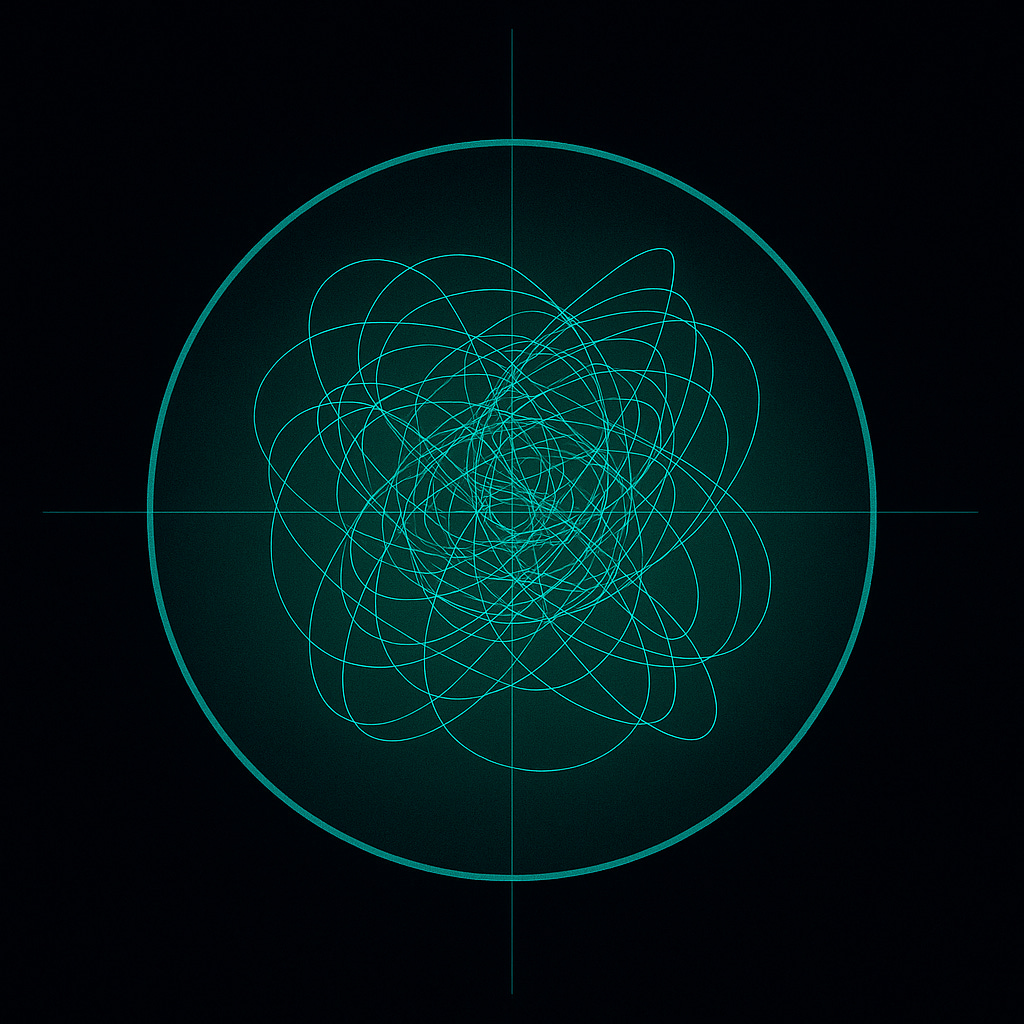
Consider:
In mathematics, the boundary of a circle is its circumference: a perfectly smooth curve, every point equidistant from the center. Unlike a polygon, it has no vertices or sharp edges—no discontinuities, only continuity. Yet, paradoxically, that very line—soft, unbroken, un-angled—defines the limit of the circle. It is an “edge” in the sense of demarcation, not in the sense of sharpness.
The circle’s edge is definitive: it sets what is “inside” and what is “outside.” Yet it is not jagged, not a wall that cuts, but a seamless boundary. Likewise, the mind has boundaries—beliefs, habits, cognitive patterns. These too are not sharp lines carved in stone, but malleable outlines. They mark what we think we know, and how we think we are.
Plasticity as Smoothness
Neuroplasticity is the brain’s capacity to reconfigure itself—forming new connections, pruning old ones. The very fact that thought is not bounded by rigid “edges” but by soft, continuous arcs makes transformation possible. In youth, this plasticity is wide and pliable; with age, it narrows, yet remains possible until neural death.
So: the mind’s edge is like the circle’s circumference. It demarcates our identity and cognition, but it is not fixed in jagged finality. It bends. It adapts. It can redraw itself, however subtly, until the last synapse falls silent.
The Paradox of Defined Yet Mutable
Defined: At any given moment, you and I can say “this is my mind, my worldview, my capacity.”
Not Sharp: Tomorrow, the edge may shift—expanding, contracting, smoothing out with experience, reflection, trauma, or healing.
End-State: Only in neural death does the boundary harden into finality. Until then, like a circle on water, it ripples with possibility.
The Circle as Self
In SESAC (Self-Efficacy, Situational Awareness, and Clarity), the circle is the field of the self: the current operational range of identity, capability, and understanding.
Self-Efficacy defines the radius — the measure of how far confidence and agency extend.
Situational Awareness traces the circumference — the awareness of where “inside” ends and “outside” begins.
Clarity is the center point — the stillness from which perception radiates.
When a founder, artist, or human acts, they move within this circle. Every decision, every reflection, every relationship occurs in reference to its edges.
Edges: The Interface Between Known and Unknown
SESAC teaches that the edge is not a wall but a membrane — a living, semi-permeable boundary through which new information, energy, and challenge enter.
When self-efficacy is weak, the circle contracts. The edges pull inward; the unknown feels threatening.
When awareness expands, the edges become porous — the circle breathes.
When clarity deepens, the edge ceases to appear as separation at all, and instead as an interface between what is and what could be.
Thus, the circle’s edge is not to be defended but to be studied: it is the locus of transformation, where learning occurs.
The Human Implication
We are bounded beings—finite in lifespan, cognition, perspective.
Yet those boundaries are not harsh. They are supple enough to allow growth, learning, transformation.
A person can redraw the circumference of self many times, so long as the canvas of life still holds them.
A sharp edge may defend but cannot grow; a smooth edge can stretch, merge, adapt.
The founder with sharp boundaries resists feedback and stagnates.
The founder with permeable but conscious boundaries absorbs experience, filters it through clarity, and evolves.
Thus, the circle must be both defined and flexible — just as the mind is neuroplastic until neural death.