
Breakthrough Is Painful Metamorphosis
What We Can Learn From Nature, Part One

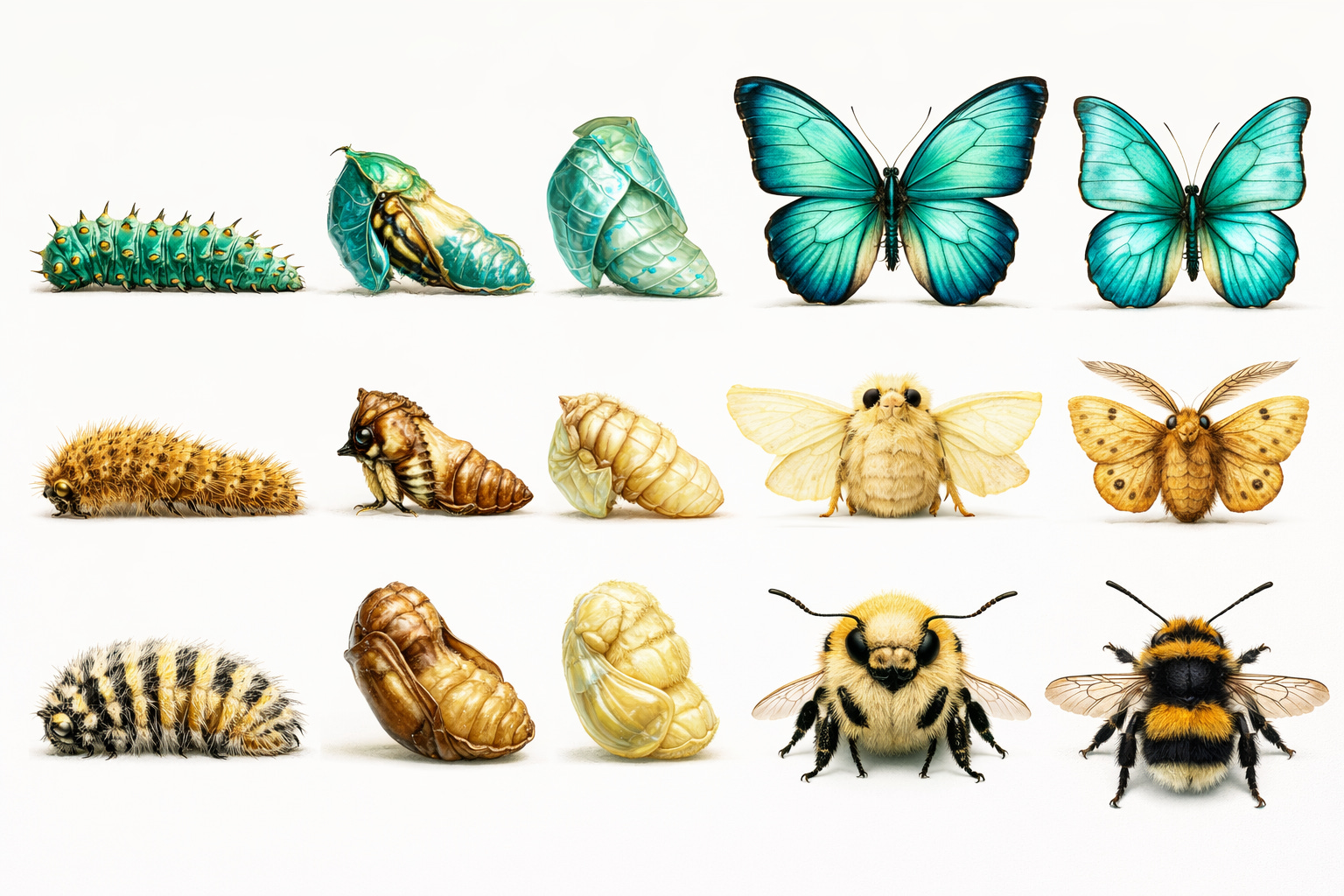
An insect’s exoskeleton is not simply armour. It is a highly engineered structure composed primarily of chitin—a long-chain polysaccharide arranged into layered microfibrils, bound with proteins and sometimes mineralized for added strength. Chitin is remarkable: light, flexible under small loads, rigid under stress, resistant to fracture, and exquisitely efficient. It allows insects to move, to leverage muscle, to withstand pressure, and to survive in hostile environments.
But chitin has one unforgiving property.
It does not grow.
Instead, it optimizes itself around a fixed geometry. Over time, that geometry becomes increasingly precise—and increasingly constraining. The exoskeleton excels at distributing stress across known patterns of motion, but it cannot accommodate expansion. Internal growth therefore produces pressure, not freedom.
This is where pain enters the system.
Pain, in biological terms, is not damage; it is information. In insects, the need to molt signifies that internal growth has exceeded structural capacity. The shell has not failed, but it is about to. The system has reached a mathematical inequality:
Internal growth > Structural tolerance
When this inequality persists, molting becomes inevitable. The discomfort preceding a molt is not pathology. It is a signal that a painful growth opportunity is imminent—one that cannot be resolved by further optimization of the existing structure.
This distinction matters deeply for human systems.
We often interpret discomfort as something to eliminate. Biology treats it as a threshold indicator. When pain appears consistently, it means growth has already occurred. The question is not whether to change, but how.
Molting is the next step—but molting is not the breakthrough.
Molting is subtraction. The exoskeleton splits along predetermined seams. The organism exits a structure that once protected it and now endangers it. In doing so, it becomes soft, pale, semi-translucent. Its leverage disappears. Its prior strength vanishes. Its ability to perform is temporarily reduced.
This is not transformation. This is exposure.
We can express this formally:
Release ≠ Advancement
The molt removes constraint, but it does not confer capability. In fact, capability often regresses during this phase. What the molt creates is a condition of vulnerability—a necessary but dangerous interval in which reorganization can occur.
In nature, this interval is carefully managed. Molting happens in concealment, at specific times, with energy reserves already stored. The organism does not attempt to exert force while soft. It does not perform. It waits.
Only after this vulnerable interval does chitin begin to reform. New layers assemble. Fibers realign. Cross-links strengthen. Importantly, the new exoskeleton is not simply larger—it is proportioned differently. It reflects the organism the insect has already become internally.
This is metamorphosis.
Breakthrough, then, is not the moment of rupture. It is not the shedding itself. It is the quality of what reforms afterward.
We can state this as a final relationship:
Breakthrough ∝ (Integrity of Recovery × Timing of Force Reintroduction)
If force is applied too early, the structure deforms or collapses. If recovery is rushed, the shell hardens incorrectly. If vulnerability is exposed rather than protected, the organism does not survive long enough to complete the process.
This is where human systems repeatedly fail.
We announce change while molting. We perform vulnerability publicly. We attempt to scale, persuade, or lead while soft. We confuse courage with exposure and rupture with progress.
Biology offers no such confusion.
The exoskeleton teaches a quieter discipline: strength is not accumulated endlessly by adding layers. Eventually, precision itself becomes the constraint. At that point, the only path forward is release, followed by patience.
True breakthrough is not dramatic. It is exact.
It is the moment when a new structure hardens—not because it was declared, but because it fits.