
Can A Breakthrough Be Reversed?
The Back-End Of The Hockey Stick, Or A Flat World

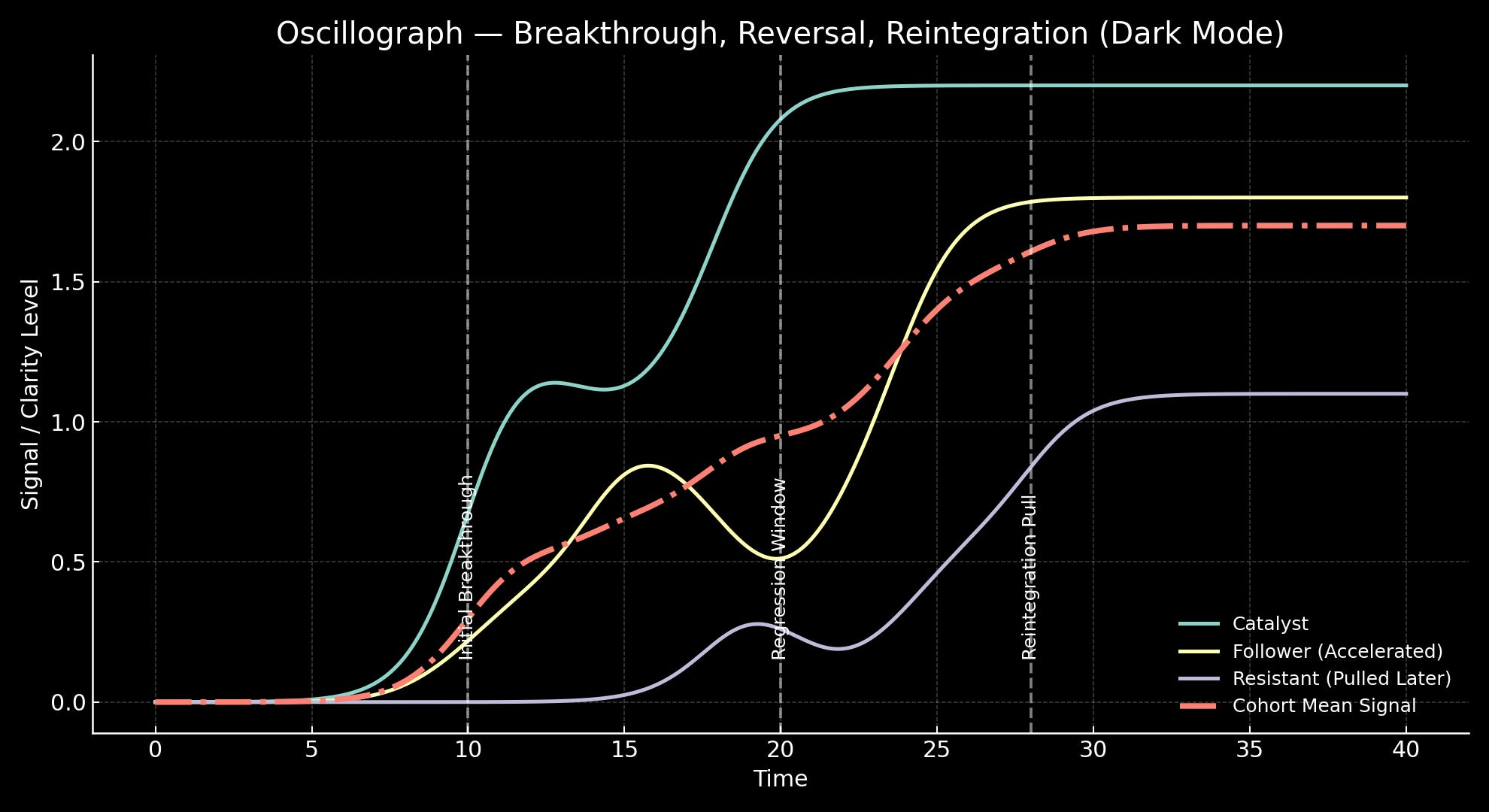
We know that breakthroughs occur. The first surge of the catalyst line—that sharp lift on the left of the oscillograph - offers compelling evidence for it. But immediately we are forced to ask: can they be reversed? The curves suggest they can. See how the catalyst’s wave, though rising, dips before stabilizing. The follower wavers more, overshooting before finding equilibrium. The resistant nearly collapses into a valley before being pulled upward. These arcs show us that the collapse of a breakthrough is not always a clean death but a period of reversion, regression, or what might look like catastrophic failure.
Using the yet-to-be-unveiled S’s Law as a framework, we recognize that continuous learning and constant iteration will not always yield outcomes that appear favorable at first glance. Yet this surface reading conceals a deeper empirical truth: our all-too-human tendency to overpersonalize and overcomplicate what we experience. In practice, this means that opinion invariably contaminates our understanding, and that perception is never the simple reflection we imagine it to be, but a prism bending reality into distortions and half-truths.
If we are to speak boldly of phenomena like a “reverse breakthrough” or a “total failure,” we must not do so on the shaky ground of intuition alone. These must be quantified—mathematically, empirically, and with reference to more than our own familiar refrain of “it feels this way.” S’s Law insists on rigor: perception must be tested against evidence, and the anecdotal must be weighed against structured observation.
At its heart, S’s Law proposes that crucibles—moments or conditions of radical transformation in self, situation, and object reality—are not fragile. They are, instead, resilient, robust, and unexpectedly fertile. Within these intense environments, what appears to be collapse may in fact be recombination; what looks like destruction may conceal the first sparks of reorganization.
Collapse may be a catalyst. We do not claim this is always the case, only that it may be. Nature gives us proof: consider the crabs clustered around the CO₂ vents of the Mariana Trench. What for their on-shore cousins would be a hostile, uninhabitable wasteland becomes, for them, the very condition of survival and thriving. Transformation under duress produces adaptations we could not predict.
So too in our ventures and our lives. S’s Law teaches us that collapse, far from a final negation, can be the hidden prelude to resilience. The task is to measure it, to model it, and to recognize that what seems like failure may be nothing more than an organism—or a founder—becoming something new in an environment it has only just begun to inhabit.
What does collapse look like? Sometimes it is a big crunch—the resistant founder’s deep trough, threatening total reversal. Sometimes it looks like heat and hubris—the noisy oscillation of the follower, rising too far too fast before gravity asserts itself. And sometimes it is the cold inactivity of drift, where the breakthrough fades back toward baseline. Yet notice: none of these collapse arcs fall below zero. Even the lowest regression retains a trace of momentum.
This is the subtle reading: perhaps reversals are not failures at all. The oscillograph’s right-hand third shows reintegration—every line, no matter how messy, bends upward again. What looked like collapse is actually part of the greater iterative process, a passage through dormancy before stabilizing into practice. Reversal is real, but it is also illusion. The imprint of the initial leap remains, and the so-called “failure” becomes a necessary oscillation on the road to lasting clarity.
Tonight, we’ll open this question at a high level.
Has our startup world been too quick to label dips as failures, misreading regressions as endings instead of phases? The oscillograph traces where reversals look lethal but are actually just troughs, and it shows the echo effect—how one founder’s surge catalyzes the others and pulls the resistant line upward.
By August 25th, we aim to refine this into a new hypothesis: that breakthrough reversals are not negations but oscillations, part of a contagion-resonance cycle governed by repetition, safety, and constraints. Collapse is not terminal. Even the deepest trough can be a staging ground for reintegration. What we once called failure may in fact be the hidden rhythm of breakthrough itself.

Source: Shape Of Life