
Mission Control for Founders: Apollo 11, Apollo 13, and Project ASTRA

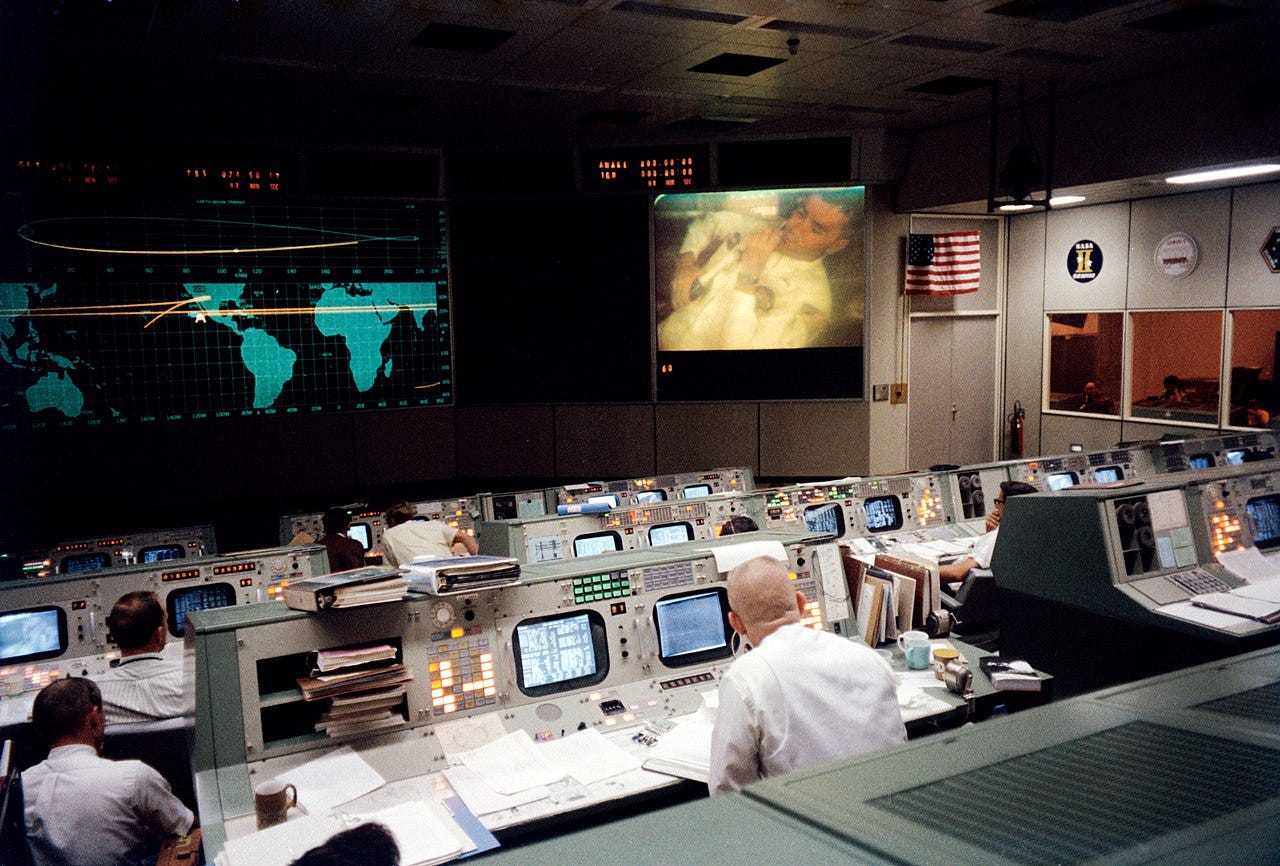
Mission Operations Control Room during the TV broadcast just before the Apollo 13 accident. Astronaut Fred Haise is shown on the screen.
The Two Moonshots
Fifty years ago, humanity learned two very different lessons about moonshots.
The first came on July 20, 1969. Apollo 11 touched down on the lunar surface, and Neil Armstrong stepped into the history books. It was the triumph of preparation, discipline, and flawless execution. Every simulation, checklist, and subsystem was aligned; every controller in Houston knew their role; the astronauts themselves embodied calm confidence born from relentless training. Apollo 11 was a victory for planning.
The second came less than a year later, on April 13, 1970. Apollo 13 was 200,000 miles from Earth when an oxygen tank exploded, crippling the spacecraft. In an instant, all plans collapsed. Systems failed, power dwindled, carbon dioxide levels climbed. And yet, through resilience, improvisation, and the unshakable trust between crew and Mission Control, the astronauts made it safely back home. Apollo 13 was a victory for resilience.
Both moments are burned into human memory because together they reveal the truth:
Great breakthroughs require both discipline and resilience.
This is the truth of startups as well.
And it is why Project ASTRA exists.
Apollo 11: The Discipline of Preparation
Apollo 11 succeeded not because luck was on its side, but because every system was checked, double-checked, and simulated hundreds of times.
Mission Control was not there to “fly the spacecraft.” The astronauts were in the cockpit, making the final decisions. But Mission Control provided the scaffolding of order and structure:
Telemetry streams told them what systems were failing or succeeding.
Checklists and flight rules reduced uncertainty into crisp decisions.
Flight directors synchronized hundreds of controllers into one unified rhythm.
For founders, Apollo 11 is the metaphor of narrative clarity, structured diagnostics, and disciplined execution.
This is where ASTRA shines as the structured intelligence layer. Our dashboards and diagnostics give founders their telemetry:
BPR (Breakthrough Potential Rating) = raw startup capability.
BPI (Breakthrough Performance Index) = live performance signal.
OP-BPI (Ongoing Performance) = the proof that progress sustains beyond the safety of a cohort.
We provide the equivalent of Mission Control’s flight rules — SESAC, PBAR, NDTI, EAR — codified protocols for making sense of chaos.
Apollo 11 reminds us: when the systems are aligned, the rocket can land. Founders who learn this discipline are capable of pulling off the most elegant of moonshots.
Apollo 13: The Discipline of Resilience
But life rarely goes like Apollo 11.
Most founders eventually live through Apollo 13.
In startup terms, the “oxygen tank explosion” can be anything: a co-founder’s departure, an investor backing out, a GTM collapse, burnout, or a product that simply doesn’t work in the market. It feels catastrophic. It drains resources. It threatens survival.
Apollo 13 survived not because its systems held, but because its people adapted. Mission Control improvised with what they had, famously redesigning a carbon dioxide scrubber using duct tape, socks, and spare parts. They told the astronauts to power down the command module and fly in the lunar module as a lifeboat. Every step was invention under pressure.
This is ASTRA’s role in the founder journey.
We detect anomalies in real time through signal diagnostics (PBAR drops, BPI collapses, drift flags).
We orchestrate improvisations: rewiring the pitch narrative, pivoting GTM focus, resetting team culture.
We build trust so founders, like astronauts, can act on advice that feels counterintuitive in the moment.
Apollo 13 reminds us: the plan will break. But the mission doesn’t have to. Founders who internalize resilience can survive even their darkest nights in space.
ASTRA as Mission Control

Founders are the astronauts. They are the ones in the cockpit, making high-stakes choices, staring into the void of the market. No one can replace their courage or conviction.
But astronauts never flew alone. Behind them was Mission Control.
That’s ASTRA.
We are Mission Control for human potential.
Together, our agents form what Mission Control called “the room.” The most trusted system of collective intelligence humanity ever built. That is what ASTRA is building for founders.
The Founder’s Moonshot
Every founder wants to believe their journey will be Apollo 11 — structured, smooth, successful.
And every founder fears their journey will become Apollo 13 — broken, chaotic, desperate.
The truth?
Every founder will face both.
Your Apollo 11 moments: the perfect investor pitch, the product-market fit breakthrough, the first customer who pays you real money.
Your Apollo 13 moments: the deal that falls apart, the experiment that burns cash, the sleepless nights wondering if you’ll make payroll.
ASTRA exists because both are part of the same trajectory. We bring founders the discipline of Apollo 11 and the resilience of Apollo 13, fused into one operating system.
The Deeper Philosophy
Why does this matter? Because founders are not simply “business operators.” They are human beings enduring extremes of stress, risk, and potential.
Apollo teaches us three deeper truths:
Success ≠ Smooth Sailing.
Apollo 13 is remembered not as a failure, but as a miracle. In startups, survival itself can be the victory that sets up the next breakthrough.Constraints Breed Innovation.
The carbon dioxide scrubber fix — “make this square filter fit into this round hole using only what’s on the ship” — is the essence of founder life. ASTRA teaches founders how to innovate with what they have, not what they wish they had.No One Wins Alone.
Astronauts are heroes, but they were never alone. Mission Control made the difference. Founders are the same: the myth of the lone genius hides the truth. The right network, system, and orchestration layer is everything.
This is why we built ASTRA. Not to replace the astronaut, but to ensure the astronaut comes home alive.
Closing: Your Mission Awaits
Apollo 11 proved humanity could reach the Moon.
Apollo 13 proved humanity could survive the impossible.
Project ASTRA proves founders can do both.
We are not here to celebrate smooth sailing. We are here to build Mission Control for your moonshot.
Whether your next step is a flawless landing or a desperate recovery, we will be in the loop — watching, guiding, and helping you return stronger.
Because founders, like astronauts, don’t just carry themselves into space. They carry all of us. And failure, as Gene Kranz reminded his team in 1970, is not an option.