
Objects, Memory, and the Fragile Promise of Tomorrow
Editorial By Project ASTRA's Steve Vilkas


Objects, Memory, and the Fragile Promise of Tomorrow
On my desk right now are three things that, at first glance, don’t belong together:
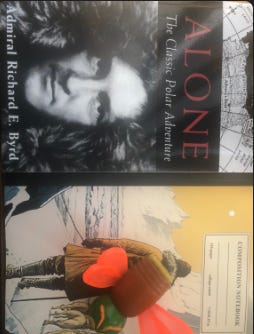
A new copy of Admiral Richard E. Byrd’s Alone.
A composition notebook wrapped in old Antarctic expedition artwork.
And a humble, 1990s McDonald’s finger puppet of a dragonfly.
Together, they hold a story I’ve been carrying for a long time.
The Book That Stood Beside Me
Many have heard and read references I’ve made to Admiral Byrd for several years. I found Byrd’s Alone years ago, rented a copy from the Boston Public Library, and even after returning it — its pathos had been with me through more difficult chapters than I can count. The book is no easy adventure tale—it’s the record of a man who chose to isolate himself in the Antarctic night, nearly dying of carbon monoxide poisoning in pursuit of data, reflection, and truth.
What struck me most wasn’t the polar darkness or the logistics of survival—it was his insistence that human beings harbor untapped inner reserves. That in the face of despair, there is always more within us. Reading Alone has reminded me, again and again, that endurance is not only physical. It’s about clarity. It’s about holding on to a thread of meaning when nothing else makes sense.
The Puppet That Saved a Child’s World
Then there is the finger puppet.
I was a little boy when pneumonia landed me in Children’s Hospital Boston. My mother stayed with me almost the entire time, never leaving my side. Except once—shortly before my discharge, she left to pick up McDonald’s. She came back with a meal and this plastic dragonfly.
I rediscovered it recently, and it nearly undid me. The toy is small, silly even—but it carries the warmth of her presence in that cold hospital room. It’s proof that love often hides in the smallest, most ordinary gestures.
Holding it now, I wish I could go back and show it to her, to tell her how much it means to me. I wish I could go back and tell her how much I love her.
Sunday, Memory, and the Present Moment
These objects—the book, the notebook, the toy—remind me of something I often forget: tomorrow is never promised.
Life is finite. No amount of work, technology, or ambition changes that. What we do have is the present moment, and the choice to live it with honesty and attention.
Admiral Byrd wrote about underutilized inner resources—strengths that only surface when we need them most. Maybe memory itself is one of those resources. Maybe the act of holding these things, and remembering, is a way of calling strength back into the present.
On a Sunday, when the world slows down just enough, I try to honor that. I look at these objects. I sit with the memories. I let them remind me that while I can’t go back, I can still live fully, love openly, and endure with grace.
A Closing Note from The Astral Dispatch
The work of founders, dreamers, and builders is not so different from Byrd’s winter at the bottom of the world, or a child clutching a small toy for comfort: it asks us to face uncertainty with courage, to pull on inner reserves we didn’t know were there, and to remember what matters most when everything else falls away.
Objects are signals. Memories are signals. They remind us that breakthrough isn’t only a moment of achievement—it’s the quiet recognition that we are still here, still alive, still capable of love and clarity.
In the end, what saves us is never abstract theory or external approval. It is the small, finite, irreplaceable things we carry with us. The dragonfly. The book. The memory of someone who stayed beside us in our darkest hours.
This is the heart of The Astral Dispatch: to notice the signals, to honor the fragile, and to live this moment as if it might be the last.