
On Equilibriums Between Faith and Reason
Uncommon Instantiation Of Trust Anticipation and Joy

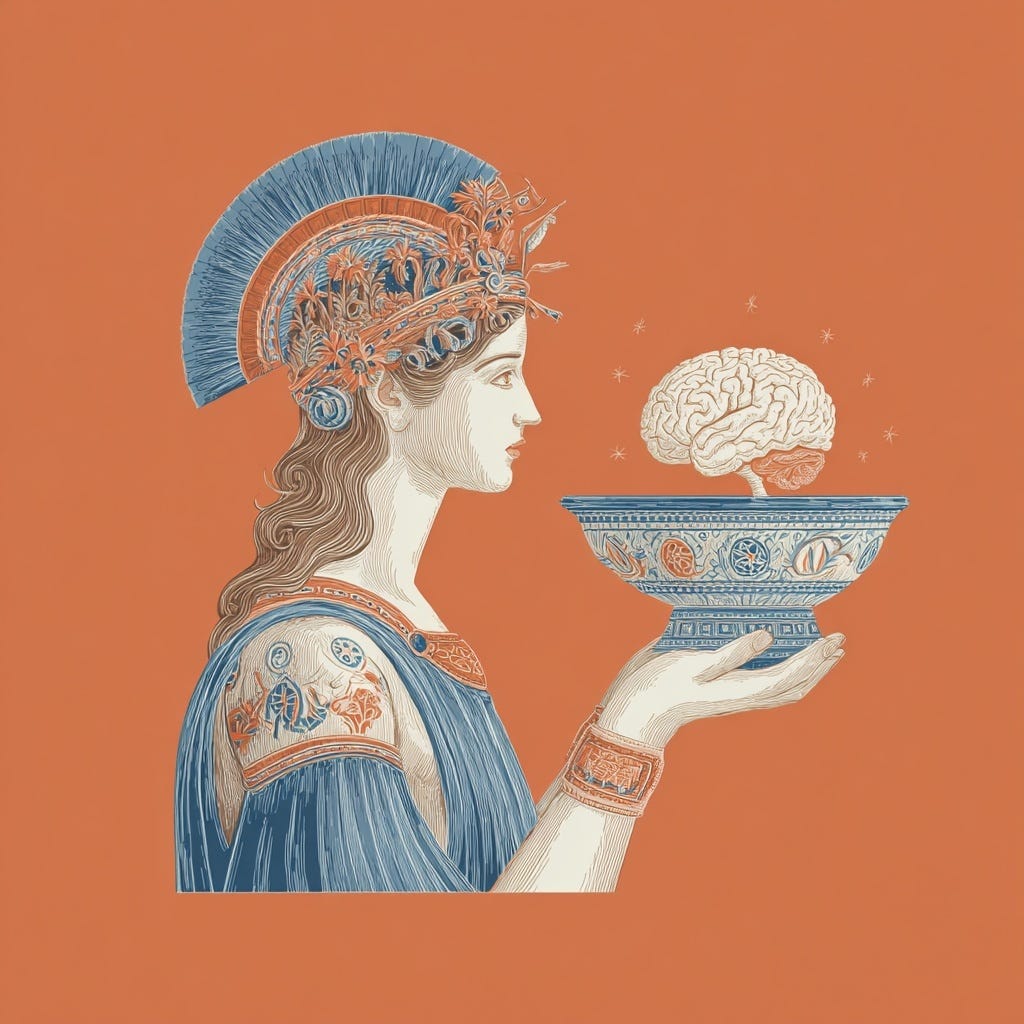
Faith is, by its very nature, a controversial topic. It commands trust in that which cannot be touched, weighed, or verified, and yet it demands of the intellect an obedience that seems contrary to the habits of rational analysis. To believe in what is invisible is to appear naïve in the age of evidence. To trust what is inscrutable is to risk folly in the eyes of those who worship data. And yet, human beings cannot live by data alone. Something in us hungers for coherence that transcends proof. That hunger — that leaning toward meaning in the face of the unmeasurable — is the root from which faith grows.
But faith in its raw, unexamined form can become dangerous. It can swell into fanaticism, or collapse into superstition. It can detach from discernment and float, untethered, into the empty heavens of self-delusion. The corrective to such imbalance is not cynicism, but the cultivation of Wise Mind — the harmonized state wherein emotion and reason cooperate rather than compete. When Wise Mind becomes the anchor, faith is no longer opposed to reason. It becomes reason’s extension into mystery. The two form an equilibrium — not a fragile compromise, but a dynamic balance capable of motion and adaptation.
This piece seeks to explore that equilibrium: how faith and reason, often portrayed as antagonists, can coexist as complementary vectors within human cognition. It will also examine how this balance aligns with the Breakthrough Theorem, which describes transformation as a function of integrated awareness and emotional coherence. Faith, in this light, is not the enemy of rationality but its necessary ally; reason, likewise, is not the foe of devotion but its protector.
Faith as the Continuation of Reason
When the philosopher Pascal spoke of “reasons of the heart which reason knows nothing of,” he was not abandoning logic — he was extending its frontier. Every scientific leap, every moral awakening, every great act of creation begins in an act of trust: a trust that there exists a pattern not yet seen, a truth not yet proven, a goodness not yet realized.
Faith, in its pure form, is anticipatory reason. It is the courage to affirm coherence before coherence has presented its credentials. To the empiricist this may seem reckless, but to the human being immersed in uncertainty it is essential. No discovery is possible without faith in discovery’s possibility. No progress can begin without belief that progress is achievable.
In the language of the Breakthrough Theorem, this is the realm of SESAC — Self-Efficacy, Situational Awareness, and Clarity. Faith aligns with all three. It expresses the inner conviction that one’s actions matter even when results are uncertain. It perceives unseen dynamics — social, psychological, moral — before data confirms them. It anticipates understanding through the fog of uncertainty.
Faith, then, is not irrational but trans-rational. It is the mind’s natural gesture toward completeness when the data set is incomplete. It affirms that reality is intelligible even when our instruments fail to measure it fully.
The Fortress of Wise Mind
Yet faith alone is insufficient. Without reason, faith loses proportion. It becomes emotional excess — a fire without a hearth. Reason’s task is not to extinguish that fire but to contain and direct it.
Here enters the Wise Mind, the integrative consciousness that mediates between logic and emotion. It is the faculty that allows feeling to inform thought without overwhelming it, and thought to refine feeling without sterilizing it.
When Wise Mind becomes the fortress, faith finds its rightful dwelling. Emotion fuels conviction; cognition guards coherence. In this equilibrium, faith becomes both reasonable and emotional, while reason becomes both analytical and compassionate.
Wise Mind corresponds to the TAJ triad: Trust, Anticipation, and Joy — the emotional correlates of cognitive clarity. These are not mere sentiments but functional variables in human equilibrium. Trust anchors the psyche against despair — the emotional parallel to faith. Anticipation directs attention toward possible futures — the affective expression of reason’s foresight. Joy confirms alignment between inner state and outer truth — the feedback signal that equilibrium has been achieved.
Wise Mind integrates TAJ with SESAC, creating a self-regulating system that preserves both coherence and vitality. It is this integration — reason informed by feeling, faith tempered by awareness — that sustains mental and moral health.
The Problem of Excess
Human systems, psychological or societal, do not fail from deficiency alone; they fail from excess. The ancient Greeks understood this: every virtue carried its vice when taken beyond balance. Courage becomes recklessness, prudence becomes paralysis, generosity becomes indulgence. So too with faith and reason.
An excess of faith leads to credulity and zealotry. It substitutes certainty for curiosity and confuses conviction with comprehension.
An excess of reason leads to sterility and despair. It reduces life to mechanism and leaves no room for wonder.
The Breakthrough Theorem codifies this as the law of DRM — the Distortion-Resistance Metric. DRM measures an individual’s capacity to resist cognitive and emotional distortion under pressure. Low DRM manifests as rigidity: the inability to adapt one’s faith to new evidence or one’s reason to human feeling. High DRM, by contrast, reflects resilience — the mind’s ability to maintain coherence without calcifying into dogma.
Equilibrium between faith and reason is not static. It is an active feedback process — a rhythm of expansion and contraction, trust and verification, wonder and critique. It is a living system of checks and harmonies, self-correcting and self-renewing.
The Anticipatory Value of Faith
One of the theorem’s more recent dimensions, AVI — the Anticipatory Value Index — measures how individuals derive psychological value from unrealized potential. Faith, in this sense, is anticipatory cognition — the creation of value before outcome.
When one believes in a future that cannot yet be seen, one generates energy for its pursuit. The belief itself becomes causative. The scientist who trusts that nature is orderly finds order because she looks for it. The artist who trusts that beauty can be born of chaos makes beauty because he persists.
Faith’s anticipatory power lies not in wishful thinking but in the ability to project coherence forward. Reason, acting through Wise Mind, refines that projection so it does not devolve into fantasy. Together, they enable what the Breakthrough framework calls constructive cognition — thinking that builds rather than merely analyzes.
Faith acts as the engine of AVI, while Wise Mind functions as its stabilizer. This relationship mirrors physics: potential energy (faith) requires structural containment (reason) to perform work without destruction. When balanced, the result is progress; when imbalanced, explosion or collapse.
The Fortress and the Field
To live by faith guided by reason is to build a fortress not of stone but of understanding. Yet the fortress alone is insufficient; one must also venture into the field of uncertainty where new truths dwell.
The Breakthrough Theorem speaks of the transition from Baseline Performance (BPR) to Program Performance (BPI) — the movement from stability to adaptive excellence. Baseline corresponds to reason’s secure citadel; program corresponds to faith’s daring exploration.
Reason defines the boundaries of safety. Faith compels the crossing of those boundaries toward growth. Wise Mind ensures that the traveler returns from the field with insight rather than injury.
In personal development as in science, civilization, or love, the cycle repeats: equilibrium disrupted, growth demanded, new equilibrium achieved. Faith propels, reason integrates, and Wise Mind harmonizes the two into continuous evolution. The fortress stands not to imprison the spirit but to preserve it through transformation.
Equilibrium as Ethical Discipline
To speak of equilibrium is not to advocate tepid moderation. True balance is not the avoidance of extremes but the mastery of them — the stillness of a dancer mid-turn.
Ethically, this equilibrium manifests as humility before mystery and courage before uncertainty. Faith without reason may lead to cruelty justified by conviction; reason without faith may lead to apathy disguised as wisdom. Only when the two are interwoven does morality gain both firmness and compassion.
The equilibrium between faith and reason therefore becomes an ethical method: to test belief through understanding, and understanding through belief.
In practical Breakthrough terms, this is the feedback loop between SESAC and TAJ — between the intellect’s clarity and the heart’s trust. Each corrects and refines the other. When trust strays into naïveté, clarity recalls it to evidence. When clarity hardens into cynicism, trust softens it back into empathy. The moral result is wisdom animated by love — the condition that allows a mind to act decisively without arrogance and to doubt without despair.
The Psychology of the Equilibrium
From a psychological standpoint, equilibrium between faith and reason aligns closely with mental health.
The human brain is not a magical lump of muscle and electricity; it is a harmonium of affect and analysis. Our prefrontal cortex plans, but our limbic system propels. Rational cognition without emotional resonance yields inertia. Emotional intensity without cognitive containment yields chaos. The balance of these systems — mediated through mindfulness, metacognition, and compassion — constitutes what the Breakthrough model calls a high-coherence state.
In this state, one’s beliefs and behaviors are aligned. The heart and head move in tandem. Cognitive distortions lose their grip because both emotion and reason are integrated into the evaluation process.
Equilibrium is not merely a metaphysical idea but a measurable neurological pattern: reduced amygdala hyperactivity, increased prefrontal regulation, enhanced interoceptive accuracy. The mystic’s serenity and the scientist’s clarity are, in truth, neurophysiological siblings.
The Philosophical Bridge
Philosophically, faith and reason represent two modes of access to truth. Reason apprehends how things are; faith intuits why they matter. The first operates through analysis, the second through meaning. Each without the other is incomplete.
The Breakthrough Theorem proposes that transformation occurs when meaning and mechanism converge — when understanding how merges with understanding why. This is what makes faith essential: it restores purpose to process. Reason may map the world, but faith gives us a reason to inhabit it.
To live entirely by reason is to stand outside life, observing it as an object. To live entirely by faith is to drown within it, unable to distinguish signal from noise. To live by equilibrium is to stand at the confluence — seeing clearly, feeling deeply, acting wisely.
It is, in a word, breakthrough.
The Dialectic of Knowing and Believing
The dialectic between faith and reason is as old as philosophy itself — from Aristotle’s balance of logos and ethos to Aquinas’s reconciliation of theology and philosophy, to Kierkegaard’s leap of faith and Einstein’s reverence for mystery. What unites these traditions is the recognition that human understanding moves by rhythm: from evidence to intuition, from intuition to evidence again.
The Breakthrough system rearticulates this rhythm in modern psychological terms. Faith corresponds to Trust and Anticipation; Reason corresponds to Clarity and Awareness. The movement between them — moderated by Wise Mind — is the process of breakthrough itself.
When faith exceeds reason, the system overheats, yielding distortion.
When reason exceeds faith, the system cools into paralysis.
When the two equilibrate, energy flows smoothly; insight arises; action becomes effortless.
The equilibrium is not a midpoint but a living synthesis — the point at which contradiction dissolves into cooperation.
The Joy of Clarity
The phrase “the joy of clarity” captures this synthesis perfectly. Joy here is not mere pleasure but the serenity that follows alignment. When faith and reason converge, joy appears naturally, as light follows dawn.
Joy is evidence that coherence has been restored. In the Breakthrough model, it is the emotional signal of successful integration — the “Aha” moment of the psyche when understanding and trust become one act. It is both reward and guide, confirming that the system is functioning in harmony.
Joy, not certainty, is the true measure of faith. Certainty can be feigned; joy cannot. It arises only when truth and trust coincide. The wise mind recognizes this and treats joy not as indulgence but as information — the indicator that one has touched reality without distorting it.
Toward a Rational Spirituality
The reconciliation of faith and reason points toward a new form of spirituality — one neither dogmatic nor nihilistic, neither sentimental nor mechanical. It is a rational spirituality, a discipline of awareness that honors mystery without surrendering discernment.
Such spirituality aligns with the Breakthrough ethic: to integrate all faculties toward coherent living. It sees the intellect not as the enemy of the soul but as its ally, the lamp that makes devotion intelligent. It sees emotion not as the corrupter of logic but as its companion, the warmth that keeps reason humane.
In this synthesis, meditation becomes analysis, and analysis becomes meditation. To think clearly is to pray; to feel deeply is to know. The human being becomes a vessel through which understanding and love flow in continuous circulation.
This is the highest equilibrium — the Breakthrough Equilibrium — where self-efficacy and surrender coexist, and where the individual, balancing between the known and the unknown, becomes a participant in creation itself.
The Practical Application
How does one cultivate this equilibrium?
The answer is neither mystical nor complicated. It lies in practice — in the small, steady acts of integration that refine both intellect and heart.
Observe the interplay between feeling and thought. Do not suppress one or glorify the other.
Question beliefs with compassion, and analyze facts with humility.
Pause before reaction, allowing Wise Mind to arbitrate between impulse and inertia.
Act in trust when certainty is impossible, but review action in light of new evidence.
Reflect on joy as feedback — not proof of correctness, but signal of alignment.
These disciplines are not ends in themselves but methods of maintaining cognitive hygiene — the ongoing prevention of distortion. Through them, the individual achieves what the Breakthrough program calls dynamic coherence: stability in motion, clarity in complexity, serenity amid uncertainty.
The Living Balance
The equilibrium between faith and reason is not a compromise but a marriage. It does not silence the tension between belief and proof; it transforms that tension into energy. Through it, the human mind learns to walk the narrow bridge between chaos and rigidity — creative, humble, alive.
Faith alone can comfort but not correct. Reason alone can explain but not sustain. Only their union can generate meaning that endures.
In the language of the Breakthrough Theorem, this union produces optimal SESAC and TAJ coherence, high DRM resistance, and maximum AVI potential. In the language of the spirit, it produces peace.
Faith gives us courage to act before certainty. Reason gives us wisdom to revise after experience. Wise Mind unites them, ensuring that neither overwhelms the other.
To live in this equilibrium is to stand in the very center of transformation — where clarity becomes joy, and trust becomes understanding. It is to discover that faith was never the opposite of reason, but its completion; and that reason, when purified of pride, is faith’s most loyal guardian.
This, then, is the foundation and the fortress:
To believe intelligently, to think compassionately, and to live in harmony with both the seen and the unseen.
To walk with both compass and heart.
To trust, to inquire, to rejoice — and to remain balanced between the two wings that make the human soul capable of flight.
Tomorrow I will provide the correlation to startups and the effects on the experiences of founders, teams, and ecosystems.