
Tectonics and Volcanic Ruptures in the Context of Breakthrough Science
The Ground Beneath Our Feet

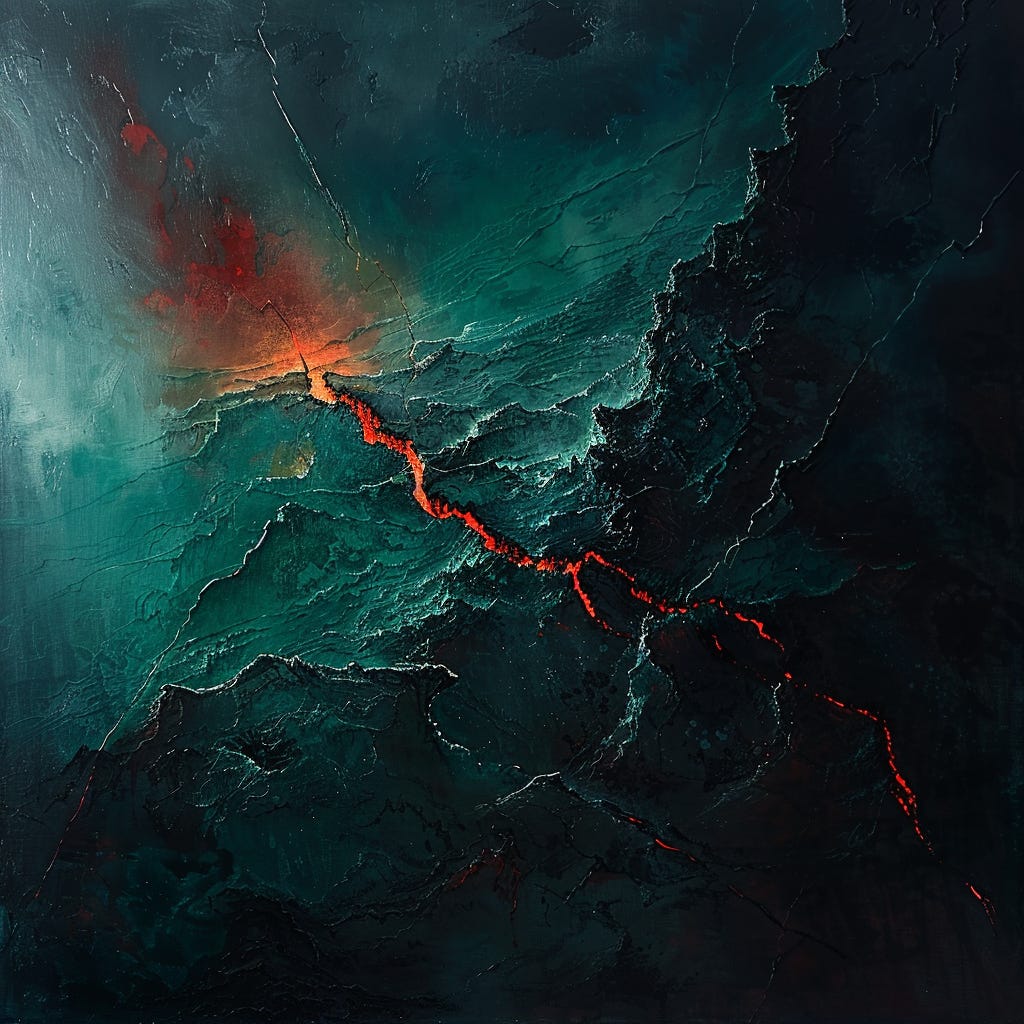
Introduction: The Ground Beneath Our Feet
Science, innovation, and human striving rarely move in a straight line. More often they move like the Earth itself: through pressures that build quietly below the surface, through sudden ruptures that reshape entire landscapes, and through long periods of silence where movement is imperceptible but no less real. To speak of “breakthroughs” is therefore to invoke geology as much as epistemology.
A breakthrough is not merely an “idea” or “invention” but a tectonic event — a shift in the plates of human understanding — or a volcanic rupture, a violent release of tension that could no longer be contained. This essay explores that metaphor as applied to what I call breakthrough science: the study of how transformative insights emerge, pause, regenerate, and integrate into lived systems.
Over the next several sections, I will unfold this metaphor with examples from science, history, and startups. We will see how breakthroughs pause, how they regenerate, why eruptions sometimes seem inevitable, and how founders, researchers, and seekers alike can learn to forecast the weather of transformation.
By the end, breakthroughs will appear not as isolated sparks but as ecological events in the landscape of innovation: tectonic drifts, volcanic eruptions, and the fertile soils they leave behind.
The Tectonic Metaphor
Slow Accumulation
The tectonic metaphor begins with the understanding that most of what changes in science and startups is invisible at first. Just as continents drift a few centimeters each year, founders spend weeks refining decks, scientists conduct countless replications, and communities build trust molecule by molecule. Nothing seems to be moving — until suddenly, everything is different.
Tectonic breakthroughs occur when cumulative forces shift the very foundation upon which knowledge is built. Darwin’s theory of evolution was not a bolt from the blue but the slow drift of comparative biology, fossil evidence, and his own patient notebooks. The “AI revolution” did not erupt solely with transformer architectures in 2017 but built upon decades of gradient descent refinements, hardware improvements, and obscure conference papers no one read at the time. The tectonic is long, slow, almost dull — but it is precisely this patience that makes mountains.
Invisible Transformations
The danger of tectonic breakthroughs is that their magnitude is invisible in real time. They arrive disguised as incrementalism, as “more of the same.” When plate tectonics themselves were first proposed in geology, the theory seemed unremarkable to many. It was only decades later that we recognized it as the organizing principle of Earth science. Similarly, founders may implement small practices — a new feedback ritual, a slight tweak in product onboarding — not realizing they have already crossed into an entirely new ecosystem of growth.
For this reason, tectonic breakthroughs often require retrospection to be appreciated. In the moment they feel ordinary, but in hindsight they appear inevitable. They teach us humility about the present: we may be standing on a mountain even when we think we are in a valley.
The Volcanic Metaphor
Violent Rupture
By contrast, volcanic breakthroughs are anything but invisible. They are sudden, dramatic, and impossible to ignore. A founder pitches the same tired narrative until one day, under the pressure of repeated rejection, a mentor delivers brutal feedback that forces a pivot. A scientist pursues a flawed hypothesis for years until a surprising experimental result shatters the paradigm. These are eruptions — events where suppressed tensions explode into view.
Volcanic breakthroughs are often born of stress. The tectonic plates of effort, denial, and aspiration grind against one another until a rupture becomes inevitable. When the eruption comes, it can be destructive — companies fail, reputations collapse, teams scatter. But eruptions also fertilize. The ash of volcanic soil is famously fertile, producing vineyards and forests where once there was devastation. Likewise, a failed experiment may birth a Nobel Prize, a collapsed company may seed three more resilient ventures, and a founder’s moment of crisis may become their most enduring lesson.
The Dual Nature of Fire
We must recognize that eruptions are neither purely destructive nor purely creative. They are both. The danger lies in the human desire to ascribe causality — to say the eruption happened because of sin, negligence, or divine will. But just as a volcano erupts because it must, sometimes the rupture in science or startups has no satisfying “reason.” It simply happens, the result of forces beyond any individual’s control: shifting markets, regulatory accidents, biological randomness. The founder who learns from this does not ask, “Why me?” but instead, “What can be harvested from this soil?”
Volcanic breakthroughs thus serve as reminders that the cycle of innovation includes destruction as a generative force. What appears to be an ending often conceals a beginning.
Do Breakthroughs Pause?
The Liminal Suspension
Here lies one of the most fascinating questions: can breakthroughs pause? The answer is yes, though not in the mechanical sense of pressing “stop.” A breakthrough pauses like a wave that has risen but not yet broken. In the life of a founder or scientist, such pauses often come during illness, distraction, or periods of survival. My own pneumonia forced a pause — not of insight itself, but of my ability to act upon it. The breakthrough was suspended in the ether, waiting for the body to recover.
The Ecology of Dormancy
A paused breakthrough is not dead. It enters dormancy, like a seed awaiting rain. During this time, two things happen:
The context continues to evolve — markets shift, competitors move, opportunities close.
The agent metabolizes the insight unconsciously — dreams, quiet reflections, background processing.
When the pause ends, the breakthrough may regenerate in altered form. It may no longer be the same flame but a mutated spark, reshaped by the dormancy itself. Illness, then, is not just interruption but transformation. The pause is part of the breakthrough’s lifecycle, a necessary crucible for integration.
Can Breakthroughs Be Forecast?
Toward a Meteorology of Innovation
If tectonics and volcanism are metaphors, meteorology is their application. Just as we cannot predict earthquakes with precision but can forecast storm likelihoods, so too can we forecast breakthrough conditions. Internal stress, structural fault lines, external climate, and triggers all serve as inputs to a kind of “breakthrough weather dashboard.”
Pressure Systems (Internal Stressors): Founder fatigue, negative BPR trends, lack of clarity.
Fault Lines (Structural Weaknesses): Fragile governance, customer concentration, single points of failure.
Atmospheric Conditions (External Trends): Market downturns, regulatory shifts, competitive intensity.
Stormfronts (Trigger Events): Illness, investor rejection, product failures.
By weighing these factors, we can forecast whether a founder is in “clear skies,” “cloud formation,” “storm watch,” or “eruption warning.” This does not prevent rupture, but it gives the agent time to prepare resilience, much as hurricane warnings allow families to evacuate.
The Necessity of Eruption
Revelation
Every eruption reveals. It exposes what was hidden — bad codebases, flawed assumptions, fragile leadership. Without eruption, these truths remain buried. Just as volcanoes vent the Earth’s interior, breakthroughs vent the unconscious layers of denial. Revelation is painful but clarifying.
Redistribution
Eruptions also redistribute. Ash fertilizes, rivers reroute, ecosystems adapt. In startups, eruptions redistribute talent, redirect strategy, and reallocate capital. The most successful founders are those who recognize the fertility in the ash, harvesting meaning rather than lamenting destruction.
Irreducible Uncertainty
But perhaps the most important necessity is humility. No matter how much we plan, we are at the mercy of forces larger than ourselves. Just as hurricanes do not ask permission to destroy, markets do not wait for our readiness to collapse. The hidden necessity of eruption is the reminder that we are not gods but navigators, stewards of a vessel in unpredictable seas.
The Lifecycle of a Breakthrough
To synthesize, we can articulate the lifecycle as an ecological system:
Spark — sudden ignition, often small.
Flame — active transformation, momentum builds.
Pause — illness, distraction, or fatigue suspends action.
Dormancy — breakthrough recedes but does not vanish.
Regeneration — re-ignition in evolved form.
Integration — breakthrough becomes lived practice or dissipates.
Within this ecology, tectonic shifts feed volcanic eruptions, which in turn redistribute nutrients back into the tectonic system. Breakthroughs are not linear but cyclical, not isolated but ecological.
Historical Cycles of Forecasting
Human history is filled with attempts to forecast rupture. Ancient cultures built temples near volcanoes not because they misunderstood the danger but because they recognized the fertility of eruption. In medieval Europe, comets were read as signs of upheaval, a kind of celestial forecast of terrestrial change.
In science, forecasting has often taken the form of trend extrapolation. Moore’s Law was less a prophecy than a tectonic recognition of pressure building in semiconductor capacity. The Green Revolution in agriculture erupted only after decades of quiet research, but hunger forecasters saw the storm clouds forming.
The lesson: forecasting does not eliminate uncertainty, but it conditions us for humility. We are not masters of the Earth; we are students of its cycles.
Rituals of Resilience
Forecasts are not enough; they must be paired with rituals. Just as coastal towns rehearse hurricane drills, founders can rehearse breakthrough resilience. Rituals might include:
Weekly SESAC check-ins to measure pressure systems.
Trust circles (TAJ pulses) to prevent fault lines from widening.
Scenario rehearsals — what will we do if funding dries up, if the market collapses?
Recovery days to sustain energy, protecting the tectonic base from erosion.
These rituals do not prevent eruptions, but they reduce devastation and accelerate regeneration. They transform forecasting from abstract awareness into lived preparedness.
Implications for Founders and Scientists
Health as Infrastructure
Illness demonstrates the fragility of breakthroughs. A founder may hold the most dazzling vision, but without health, the breakthrough stalls. Health must therefore be considered part of the infrastructure of innovation. Sleep, nutrition, psychological safety — these are not luxuries but tectonic foundations.
Feedback as Seismology
Founders who ignore feedback are like citizens who ignore tremors. Seismology is not prediction but detection. Regular feedback loops, SESAC check-ins, and BPR monitoring serve as seismic instruments that detect tectonic pressure before it erupts volcanically.
Learning as Fertility
After rupture, the founder must become a farmer of volcanic soil. What new practices, narratives, or products can grow here? The question is not “how do we return to the old world” but “how do we cultivate the new?”
The Philosophy of Breakthrough Ecology
At the deepest level, this metaphor teaches us a philosophy of contingency. Breakthroughs are not neatly engineered but lived, messy, sometimes violent. They remind us of the humility of existence. We crave reasons — why the volcano erupted, why the hurricane struck — but often there is no satisfying cause beyond “because that is how the system works.”
And yet, in this randomness lies beauty. Because meaning is not given, we are free to create it. We can harvest learning from destruction, fertility from ash, humility from uncontrollable forces. The ecology of breakthroughs is not deterministic but generative, giving us endless opportunities to interpret, adapt, and grow.
Breakthrough Science as Expedition
One might imagine the pursuit of breakthroughs as an expedition across shifting terrain. The tectonic movements are like continental drift, carrying us silently across oceans. The volcanic eruptions are like storms, sudden and terrifying, but also awe-inspiring. The role of the founder, scientist, or seeker is not to master these forces but to navigate them, to build resilient vessels, and to keep moving even when the ground shakes.
Breakthrough science, then, is not about triumph alone. It is about endurance, humility, and reverence for forces larger than ourselves. It is about becoming a cartographer of invisible plates and a meteorologist of unpredictable storms.
Conclusion: Living With Breakthroughs
Tectonic and volcanic metaphors teach us that breakthroughs are both patient and violent, both silent and spectacular. They pause, they regenerate, they erupt, they integrate. They are not moments but lifecycles, not sparks but ecologies. To live with breakthroughs is to live with humility, to respect the inevitability of rupture, and to cultivate fertility in the aftermath.
In the end, the greatest lesson of breakthrough science is not control but participation. We cannot stop tectonic drift. We cannot forbid volcanic fire. But we can learn to read the tremors, to forecast the storms, and to build communities resilient enough to endure them.
And if we are fortunate, when the ash clears, we will find ourselves standing on new mountains we never could have imagined — mountains born from the slow patience of tectonics and the fiery revelation of rupture.
Afterword: Startups That Read the Ground
History offers examples of companies that respected both tectonic and volcanic threats.
Airbnb (2008–2010): During the financial crisis, the tectonic pressure of a global downturn forced lean experimentation. Their “volcanic” rupture came when their early model nearly collapsed. Instead of folding, they leaned into resilience — creating the now-famous cereal box hustle to survive. The ash of that near-eruption fertilized their cultural DNA of scrappiness and design-led empathy.
Slack (2013–2015): Born from the ashes of a failed gaming startup (Glitch), Slack emerged precisely because a volcanic rupture forced the team to abandon their original dream. Yet the tectonic accumulation — years of refining internal tools and team communication — created the conditions for an explosive pivot. What seemed like failure became the fertile ground for one of the fastest-growing SaaS companies in history.
Both illustrate that founders who recognize the inevitability of tectonic drifts and volcanic ruptures can endure the cycles of breakthrough science. They did not seek to control nature, but to learn from it.
In the coming weeks, case studies from our own cohorts will follow.